The course helps you explore diverse and respected career options. Qualified CS professionals can work in corporate law firms, MNCs, and more.
The course will help you learn company law, security regulations, & business ethics in detail. It helps you develop practical skills to manage legal compliance, conduct board meetings, and draft policies.
CareerAligns Company Secretary (CS) professional course is the highest qualification when it comes to governance, corporate law, and compliance. With this course, you will be able to develop your practical skills in several areas. The areas are secretarial practice, company law, finance, corporate governance, and ethics. The course has a structured path from an initial foundation at the executive level to the final professional stage. This will help you build knowledge progressively. At the same time, you will also get to know about real-world corporate processes.
In this course, the main subjects are securities laws, corporate laws, compliance management, and board processes. This helps the students to advise boards, manage statutory records, and ensure regulatory filings are correct and timely. The curriculum is a combination of theory & practical. Thus, helping students to learn rules along with how to use them.
Once you complete the Company Secretary (CS) professional course, you will get a strong career aspect in both the private & public sectors. Moreover, they can get jobs in financial institutions and consultancy firms. This is due to their expertise in governance and regulatory matters. A CS can play a major role in shaping board policies and managing investor relations. Not only this, but they also play a key role in ensuring ethical corporate conduct. The demand for trained secretaries has increased a lot. This is because of the increasing regulatory focus & corporate accountability. Thus, making the qualification valuable for professionals who want to have legal knowledge with a business strategy. The course has practical training, which is very important. This is because it provides hands-on experience with compliance filings, secretarial audits, and more.
The CS professional course by CareerAligns provides a professional identity & opportunities for leadership roles. It is best for all those who want to enjoy legal reasoning, organizational systems, and strategic oversight. Additionally, the program also helps you get a role in mergers and acquisitions, compliance audits, organizational systems, & strategic oversight.
Want To Learn More?
CS Professional Curriculum
Explore environmental, social, and governance frameworks for building responsible, compliant, and sustainable business organizations.
Section A: Governance and Sustainability
Conceptual Framework of Corporate Governance
Legislative Framework of Corporate Governance in India
Board Effectiveness
Board Processes through Secretarial Standards
Board Committees
Building Better Boards
Concept of Governance in Professional Managed Company & promoters Driven Company
Board Disclosures and website disclosures
Data Governance
Stakeholders Rights
Business Ethics / Code of Conduct and Anti-bribery
Board’s Accountability on ESG
Environment
CSR
Green Initiatives
Governance Influencers
Empowerment of the Company Secretary Profession
Section B: Risk Management
Risk Management Overview
Section C: Environment & Sustainability Reporting
Sustainability Audit
Integrated Reporting Framework
Learn the art of legal drafting, preparing pleadings, and making effective appearances before authorities and judicial bodies.
Section A: Drafting and Conveyancing
Types of Documents
General Principles of Drafting
Laws relating to Drafting and Conveyancing
Drafting of Agreements, Deeds, and Documents
Drafting of Commercial Contracts
Documents under the Companies Act, 2013
Art of Opinion Writing
Commercial Contract Management
Section B: Pleadings and Appearances
Judicial & Administrative framework
Pleadings
Art of Advocacy and Appearances
Applications, Petitions and Appeals under the Companies Act, 2013
Adjudications and appeals under SEBI Laws
Appearance before other Regulatory and Quasi-judicial Authorities
Develop professional skills in managing compliance, conducting audits, and performing due diligence to safeguard corporate interests effectively.
Section A: Compliance Management
Compliance Framework
Documentation & Maintenance of Records
Signing and Certification
Legal Framework Governing Company Secretaries
Values Ethics and Professional Conduct
Non-Compliances, Penalties and Adjudications
Relief and Remedies
Section B: Audit & Due Diligence
Concepts of Various Audits
Audit Engagement
Audit Principles and Techniques
Audit Process and Documentation
Forming an Opinion & Reporting
Secretarial Audit
Internal Audit & Performance Audit
Peer Review Audit and Quality Review Audit
Due Diligence
Gain knowledge of CSR policies, sustainability goals, and governance standards fostering responsible corporate citizenship and social welfare.
Section A: Corporate Social Responsibility
Corporate Social Responsibility
CSR Policy
CSR Projects & Implementation Agency
Social Impact Assessment & CSR Audit
Guidelines on CSR
CSR and Sustainable Development Goals
Impact of CSR
Section B: Social Governance
Social Governance
Social Stock Exchange
Contribution of Non-Corporate Entities (NCE) in Social Governance
Societies and Trusts
Partnership Firms
Model Code for Meetings of Non-Corporate Entities
Financial and Non-financial Reporting of Different Non-corporate Entities
Foreign Funding to Non-Corporate Entities
Local Self Governance
Explore internal audit mechanisms and forensic techniques for accurate reporting, fraud prevention, and compliance assurance.
Section A: Internal Audit
Internal Audit: Introduction & Overview
Practices related to Internal Auditing
Internal Controls
Internal Audit Engagements and Planning
Internal Audit Tools and Techniques
Internal Audit of Specific Functions
Special points relating to internal audits in various entities
Reporting under Internal Audit
Emerging Issues and Challenges
Section B: Forensic Audit
Basic Concepts of Forensic Audit
Audit and Investigations
Forensic Audit
Forensic Audit and Indian Evidence Law
Cyber Forensics
Fraud Detecting Techniques
Gain knowledge of IP rights, enforcement mechanisms, and legal procedures to protect and manage intellectual creations.
Introduction
Types of Intellectual Property
Role of International Institutions
Indian Patent Law and its Developments
Patent Databases & Patent Information System
Patent Documentation, Examination, and Infringement
Trademarks
Copyrights
Industrial Designs
Geographical Indications
Layout- Designs of Integrated Circuits
Protection of Trade Secrets
Biological Diversity
Protection of Plant Varieties
Business Concerns in Commercializing Intellectual Property Rights
Master legal practices for AI, analytics, and cyber security to safeguard data, privacy, and digital business operations.
Section A: Legal & Compliance Perspective
Artificial Intelligence
Cyber Security
Cyber Threats and Cyber Laws
Cyber Crimes and Investigation Procedures
Regulatory Framework on AI, Cyber Security and Cyberspace
Data Analytics and Law
Section B: Technological Perspective
Computer Hardware and Software
Network Basics and Security
Software and Software Security
Database Management
Data Analytics
Information Systems
Management Information Systems
Enterprise Resource Management
Internet and Other Technologies
Learn strategic planning, corporate finance principles, and financial decision-making to enhance business growth, profitability, and long-term organizational success.
Section A: Strategic Management
Introduction to Strategic Management
Analysing the External and Internal Environment
Business Policy and Formulation of Functional Strategy
Strategic Analysis and Planning
Competitive Positioning
Managing the Multi-Business Firm and Analyzing Strategic Edge
Section B: Corporate Finance
Sources of Corporate Funding
Raising of Funds from Equity and Procedural aspects
Raising of Funds from Debt and Procedural aspects
Foreign Funding–Institutions
Foreign Funding–Instruments, laws, and Procedures
Role of Intermediaries in Fundraising
Project Evaluation
Explore strategies for restructuring, valuation techniques, and insolvency management to maximize value and maintain compliance.
Section A: Corporate Restructuring
Types of Corporate Restructuring
Acquisition of Company / Business
Planning & Strategy
Process of M & A transactions
Documentation–Merger & Amalgamation
Accounting in Corporate Restructuring
Taxation & Stamp Duty Aspects of Corporate Restructuring
Regulation of Combinations
Regulatory Approvals of Scheme
Fast Track Mergers
Cross Border Mergers
Section B: Valuation
Overview of Business Valuation
Valuation of Business and Assets for Corporate Restructuring
Section C: Insolvency, Liquidation & Winding Up
Insolvency
Application for Corporate Insolvency Resolution Process
Role, Functions and Duties of IP/ IRP/ RP
Resolution Strategies
Convening and Conduct of Meetings of the Committee of Creditors
Preparation & Approval of Resolution Plan
Pre-Packaged Insolvency Resolution Process
Cross Border Insolvency
Liquidation on or after failing of the Resolution Plan
Voluntary Liquidation
Debt Recovery & SARFAESI
Winding-up by Tribunal under the Companies Act, 2013
Strike Off and Restoration of Name of the Company and LLP
Learn arbitration, mediation, and conciliation processes to resolve disputes efficiently, maintain business relationships, and ensure fair, legal outcomes.
Section A: Arbitration & Conciliation
Arbitration: An Introduction
Commercial Transactions
Arbitration Agreement/Clauses and related concepts
Arbitration Institution
Arbitration Procedure
Appointment of Arbitrator and Other Aspects
Pleadings
Arbitral Proceedings and Evidence in Arbitration
Preparation and Execution of Arbitral Award
Challenge to Award
Appeals
Fast Track and virtual Arbitration
Arbitration under Investors' Grievances Redressal Mechanism of Stock Exchanges
Conceptual Framework of International Commercial Arbitration
International Law of Arbitration
Emerging Aspects
Introduction of Conciliation
Conciliation Proceedings
Conciliation for Micro Small and Medium Enterprises
International Perspective
Section B: Mediation
Mediation
Negotiation Skills and Communication
Process of Mediation
Various Modes and Scope of Mediation
Role of Mediation in other ADR domains
Emerging aspects
Rules relating to Mediation
International aspects
Develop skills in GST regulations and corporate tax planning to optimize financial performance and maintain legal compliance.
Section A: Goods and Services Tax (GST)
Overview of Goods and Services Tax
Supply under GST
Time of Supply
Value of Supply
Input Tax Credit & Computation of GST Liability
Procedural Compliance under GST
Assessment, Audit, Scrutiny, Demand and Recovery, Advance Ruling, Appeals and Revision
Gain expertise in insolvency laws, bankruptcy processes, and practical applications for efficient corporate debt management.
Introduction to Insolvency and Bankruptcy Code
Corporate Insolvency Resolution Process
Resolution Strategies
Fast Track Corporation Insolvency Resolution Process
Liquidation of Corporate Person
Voluntary Liquidation of Companies
Adjudication and Appeals for Corporate Persons
Pre-Packaged Insolvency Resolution Process
Debt Recovery and Securitization
Winding-Up by Tribunal
Insolvency Resolution of Individual and Partnership Firms
Bankruptcy Order for Individuals and Partnership Firms
Bankruptcy for Individuals and Partnership Firms
Fresh Start Process
Professional and Ethical Practices for Insolvency Practitioners
Group Insolvency in India
Cross Border Insolvency & IBC
Cross Border Insolvency
Get the course broacher
CS Professional Certification
The Company Secretary (CS) Professional Certification exam is the final stage of the CS program, conducted by The Institute of Company Secretaries of India (ICSI). It follows the CSEET and Executive Program levels and consists of seven subjects, which include two elective and two open-book exams. The exam is held twice a year in June and December, and passing requires a minimum of 40% in each subject and 50% in the aggregate for each group.
Course structure and progression
CSEET: The first level, a computer-based entrance test with four papers. Passing this is required to enroll in the Executive Program.
Executive Programme: The second level, comprising seven subjects divided into two groups. This exam is descriptive and has no negative marking.
Professional Programme: The final level, with seven subjects divided into two groups (one with four subjects, one with three). Two of these are elective and open-book exams.
Eligibility for Professional Programme
You must have passed the CS Executive examination.
You must also be a commerce graduate with a minimum of 55% or a graduate in another stream with at least 60%.
A mandatory 21-month article ship is also required, which can be done alongside the Professional Program.
Exam details
Frequency: The CS Professional exam is held twice a year, in June and December.
Passing Score: A minimum of 40% is required in each subject and 50% in the aggregate for each group to pass.
Mode: The exam is computer-based, but it is a descriptive exam with no negative marking.
Get Certification
CS Professional Objectives
It is a specialized program provided by the Institute of Company Secretaries of India. The course helps you learn corporate law, compliance, governance, and more.
The course is conducted by ICSI. This is a legal body under the Ministry of Corporate Affairs, Government of India.
The course has Foundation, Executive, and Professional levels. In each stage, you will learn about corporate law, strategic management, & compliance.
CS Foundation level- You can do this course if you have passed the class 12 exam in any stream (except fine arts) can do this.
CS Executive level- You can do this course if you have completed the CS Foundation or have graduated in any stream (except fine arts).
CS Professional level – You can do this if you have passed both modules of the CS Executive level.
On average, the time required is 3 to 4 years. This includes all three stages, exams, & practical training.
The CS course is hard. However, you can pass it with proper study & regular revision.
A minimum of 40% marks in each paper & 50% aggregate in every paper of the modules is needed.
Yes! You can directly register for the Executive level without appearing for the Foundation exam.
Ensures legal compliance
Manages board meetings
Maintains records
And more.
No age limit. Anyone who are eligible can join this course.
Yes! Many are doing this course along with their job.
The demand for CS professionals is high in various industries. This is mainly due to the increasing compliance requirements & corporate governance standards.
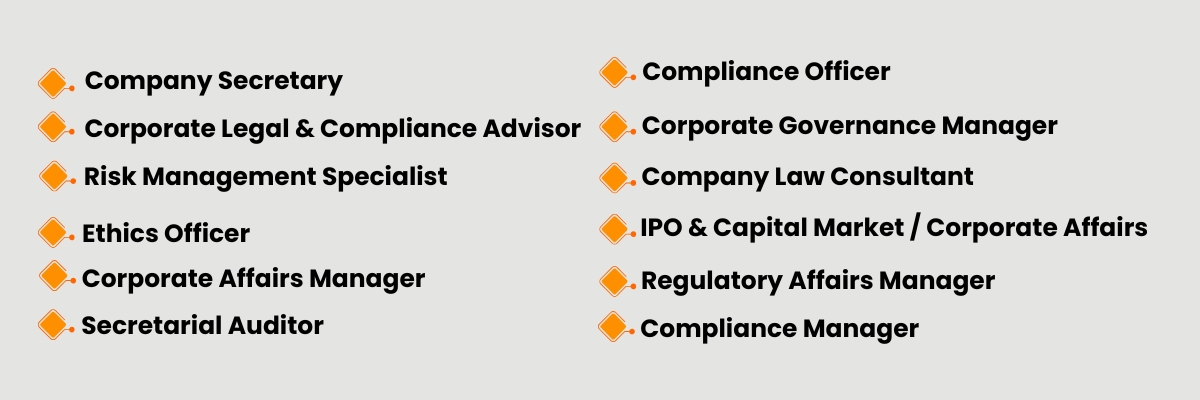
Company Secretary
Compliance Officer
Legal Advisor
Corporate Consultant
Governance Expert
Yes! Many MNCs & global law firms hire Indian CS professionals. They usually hire for governance & compliance roles.
Strong legal knowledge
Analytical thinking
Communication
Drafting
Ethical decision-making
You can attend several times, but please complete the course before the registration validity expires.
Yes! Many students pass the exam through self-study. They study with the help of relevant study materials.
No! In this course, you have to learn law, governance, & management.
You can register online through the official ICSI website. For this, you have to submit the required documents & fees.
Educational certificates
Passport-sized photo
ID proof
Scanned signature
Yes! Many students are doing this course along with their LLB or MBA.
Yes, CS professionals are eligible for government & public sector roles in various departments.
No, students from any academic background (except fine arts) can do this course.
It provides a stable, respected, and rewarding profession. Moreover, it is a combination of law, management, and strategy.
CS Professional rated
(5.0 / 5) based on 2 reviews.
Arjun
Great faculty and practical explanations. The mock tests really improved my speed and accuracy for the CS Professional exam.
Megha
Fantastic training program! The concepts were explained clearly, with regular revisions and practical examples that made learning easy and exam-ready.
Learner Experiences
Transforming Careers, One Student at a Time
Joining this institute was the best decision for my CA preparation. The faculty members explain even the toughest accounting concepts in a clear, practical way. Their revision sessions and mock tests built my confidence — I cleared my CA Intermediate on the first attempt!
Harshitha Reddy
CA Intermediate Student
The CFA training here focuses on deep conceptual understanding and real-world applications. The mentors are industry experts who make complex topics like valuation and portfolio management easy to grasp. Their constant support helped me clear Level 1 with flying colors!
Arjun Mehta
CFA Level 1 Candidate
I’m really thankful to the institute for guiding me throughout my CS journey. The classes are interactive, and the study materials are updated as per the latest ICSI syllabus. They not only teach for exams but also prepare you for a successful corporate career.


.jpg)